
By AmpleX Consultants · Published September 29, 2026 · Updated October 2, 2026
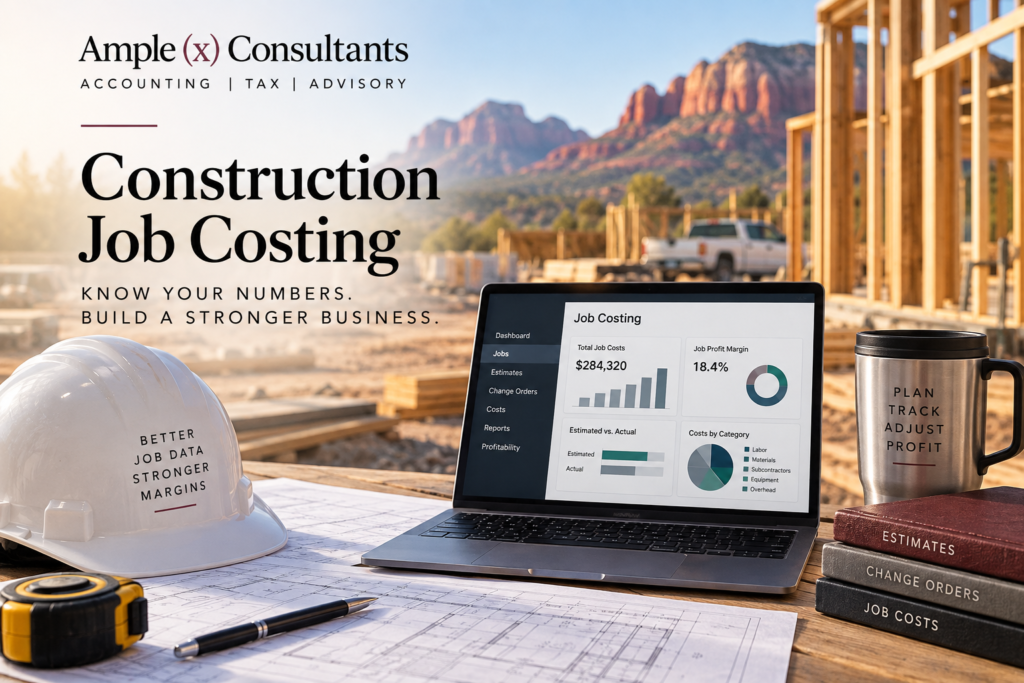
Construction job costing gives contractors something basic bookkeeping can’t: visibility into whether individual projects are actually making money. If your company is growing but you’re struggling to understand job profitability, change orders, overhead, or actual costs compared with estimates, your bookkeeping may no longer be enough.
1. You Don’t Know Which Jobs Are Actually Profitable
If your P&L shows the company is profitable overall but you can’t say which specific jobs drove that profit, you’re missing an important part of the picture.
A profitable quarter can hide two jobs that lost money and one highly profitable project that carried the entire company.
Construction job costing separates revenue and expenses by project so you can see how labor, materials, subcontractors, equipment, and other costs affect each job’s margin.
That information becomes especially valuable when deciding which types of projects to pursue. You may discover that your highest-revenue jobs aren’t necessarily your most profitable ones.
Over time, accurate job-level reporting can help you identify which customers, project types, crews, and contract structures produce the strongest margins.
2. Change Orders Aren’t Tracked Against the Original Bid
Change orders can quietly destroy the profitability of an otherwise successful project.
When additional labor or materials aren’t separately tracked, those costs become buried in the overall project. The job may finish over budget without anyone being able to clearly explain why.
A strong job-costing process allows you to compare the original estimate, approved change orders, actual costs, and final project revenue.
That gives you a much clearer picture of whether the original bid was accurate and whether additional work was properly priced.
It can also help identify recurring estimating problems. If certain materials, labor categories, or project phases consistently run over budget, your historical job data can help improve future bids.
3. You’re Estimating the Next Job Off a Gut Feeling
Experience is valuable in construction, but historical financial data should support that experience.
Without accurate job costing, your next bid may be based largely on what you remember from a similar project rather than what that project actually cost.
That can create small estimating errors that compound across multiple projects.
For example, labor may consistently take longer than estimated, material prices may have increased, subcontractor costs may be higher, or overhead may not have been properly incorporated into previous bids.
Accurate job-costing reports allow you to compare estimated costs versus actual costs after a project is completed.
The more historical information you collect, the more confidently you can price future work.
4. Percentage-of-Completion Doesn’t Match Reality
For longer construction projects, understanding how much work has actually been completed is critical for both financial reporting and cash-flow planning.
If your financial reports indicate a project is 60% complete while the project manager believes it’s closer to 80%, something deserves attention.
The difference could come from costs being assigned to the wrong job, expenses not being entered promptly, inaccurate estimates, unrecorded commitments, or billing that doesn’t reflect actual project progress.
Good construction accounting connects what is happening in the field with what appears in the financial statements.
When those two versions of the project don’t match, owners can end up making decisions based on financial information that doesn’t reflect what’s actually happening.
5. Overhead Is Getting Buried in “Cost of Goods”
Direct costs are relatively easy to associate with a project. Materials purchased specifically for a job, subcontractor invoices, and direct labor can usually be assigned to that project.
Overhead is more complicated.
Vehicles, equipment, insurance, office staff, software, rent, management time, and other shared expenses still have to be paid for by the work your company performs.
If those costs aren’t considered when evaluating job profitability, a project can appear profitable while contributing far less to the company’s actual bottom line.
The goal isn’t necessarily to assign every office expense directly to one project. It’s to develop a consistent method for understanding how overhead affects your pricing and margins. The same principle applies to labor — see true labor cost by job and retainage accounting for what often gets missed.
What Good Construction Job Costing Should Tell You
Once your system is working correctly, you should be able to answer questions such as:
- Which projects are actually profitable?
- Where are labor costs exceeding estimates?
- Which types of jobs consistently produce the strongest margins?
- Are change orders being priced profitably?
- How do estimated costs compare with actual costs?
- Are projects generating enough margin to cover company overhead?
- Which projects are creating cash-flow pressure?
Job costing shouldn’t create more paperwork simply for the sake of accounting. It should give management information that helps improve estimating, pricing, project management, and profitability.
A Worked WIP Schedule Example (Illustrative)
The numbers below are a simplified, illustrative example, not results from an actual AmpleX Consultants client. They’re meant to show how a work-in-progress (WIP) schedule connects costs, billing, and earned revenue on a single job.
A WIP schedule compares three things for each active job: how much of the estimated cost has actually been spent, how much revenue that level of progress has “earned” under the contract, and how much has actually been billed to the customer so far.
- % Complete = Costs Incurred to Date ÷ Total Estimated Cost
- Earned Revenue = % Complete × Total Contract Value
- Over/(Under) Billing = Amount Billed to Date − Earned Revenue
| Line Item | Illustrative Amount |
|---|---|
| Total Contract Value | $500,000 |
| Total Estimated Cost | $400,000 |
| Costs Incurred to Date | $300,000 |
| % Complete (Costs to Date ÷ Estimated Cost) | 75% |
| Earned Revenue to Date (75% × Contract Value) | $375,000 |
| Amount Billed to Date | $410,000 |
| Over/(Under) Billing | $35,000 overbilled |
In this illustrative example, the job is 75% complete based on cost, which means it has earned $375,000 of its $500,000 contract value. But the company has already billed $410,000 — $35,000 more than it has actually earned. That gap is what a WIP schedule is built to catch.
Overbilling vs. Underbilling: What They Actually Mean
Using the same illustrative job above, here’s what each side of that $35,000 gap would mean depending on which direction the billing went.
Overbilling: Billed Ahead of Progress
If the company billed $410,000 against $375,000 of earned revenue, it’s overbilled by $35,000. On the balance sheet, this shows up as a liability — often labeled “billings in excess of costs” — because the company has been paid for work it hasn’t finished yet.
Overbilling isn’t automatically a problem. Many contractors intentionally front-load billing to fund labor and materials early in a job. The risk is treating that cash as profit. If it gets spent as if it were earned, there may not be enough left to finish the job — or to cover the next one.
Underbilling: Progress Ahead of Billing
If instead the company had only billed $340,000 against that same $375,000 of earned revenue, it would be underbilled by $35,000. This shows up as an asset — “costs in excess of billings” — because the company has done work and incurred costs it hasn’t invoiced for yet.
Underbilling is the pattern behind one of the most common construction cash-flow problems: a company doing good, profitable work while quietly running out of cash, because the billing hasn’t caught up to the progress. See construction bookkeeping and job costing for how AmpleX Consultants tracks WIP alongside the rest of the books, and construction cash-flow forecasting for how this connects to planning ahead.
Better Job Data Leads to Better Bids
One of the biggest long-term benefits of job costing is the information it creates for future projects.
Every completed job gives your company another set of actual results to compare against the original estimate.
Instead of asking, “What do we think this project will cost?” you can look at what similar projects have actually cost your company.
QuickBooks also provides a helpful guide to job costing in construction and how contractors can track project costs and profitability.