
By AmpleX Consultants · Published September 11, 2026 · Updated October 2, 2026
Bookkeeping vs accounting vs CFO services are often talked about as though they are interchangeable, but they serve very different purposes. As a business grows, understanding the difference can help you determine what level of financial support you actually need—and when you need it.
You may start with bookkeeping, add more advanced accounting as the business becomes more complex, and eventually need controller or CFO-level guidance. The key isn’t choosing the most impressive title. It’s making sure you have the right financial support for where your business is today.
At a Glance: Bookkeeping vs. Accounting vs. Controller vs. CFO
| Role | Primary Focus | Typical Output | Usually Needed When |
|---|---|---|---|
| Bookkeeping | Recording and categorizing transactions accurately | Reconciled QuickBooks file | From day one — every business needs this |
| Accounting | Turning accurate records into usable reports | Profit & Loss, Balance Sheet | Once you need to understand, not just track, the numbers |
| Controller | Overseeing the accounting process and internal controls | Clean month-end close, reliable reporting | As transaction volume and complexity grow |
| Fractional CFO | Strategy, forecasting, and decision support | Forecasts, scenario planning, KPI guidance | When decisions get bigger than the historical numbers alone can answer |
Most businesses don’t pick one of these and stop — they add layers as they grow. The sections below go deeper on what each role actually does. If you’re evaluating a change because of your current provider, see our guide to switching bookkeepers and keeping ownership of your records.
Bookkeeping: Keeping the Financial Record Accurate
Bookkeeping is the foundation of your financial system. It focuses on accurately recording what has already happened in the business.
That typically includes categorizing transactions, reconciling bank and credit card accounts, recording income and expenses, maintaining the general ledger, and helping ensure the books match what actually occurred.
Good bookkeeping should give you confidence that the numbers you’re looking at are accurate.
But bookkeeping alone doesn’t necessarily tell you why your numbers changed, whether your margins are healthy, or what financial decisions you should make next.
You may need bookkeeping support if: your accounts aren’t consistently reconciled, transactions are miscategorized, your books are behind, or you don’t completely trust the numbers in QuickBooks.
QuickBooks also provides resources for business owners who want to better understand the difference between bookkeeping and accounting.
Accounting: Turning Accurate Records Into Useful Reports
Accounting takes the information maintained through bookkeeping and turns it into meaningful financial reporting.
This includes reviewing your profit and loss statement, balance sheet, cash-flow information, accounts receivable, liabilities, and other financial data.
The goal is no longer simply to record what happened. It’s to understand what those numbers mean.
For example, revenue may be increasing while profitability is declining. Expenses may be growing faster than sales. One service line, customer, or project may be significantly more profitable than another.
Accounting helps bring those patterns into view.
You may need stronger accounting support if: your books are accurate, but you still struggle to understand profitability, cash flow, margins, or the overall financial health of the business.
Controller: Managing the Process
As a business grows, simply producing financial statements may no longer be enough.
A controller provides another level of financial oversight. This role helps make sure the accounting process itself is working properly and that financial information is produced consistently and accurately.
Controller-level work may include overseeing month-end close, reviewing reconciliations, improving internal controls, monitoring accounts receivable and payable, reviewing financial reporting, and creating more consistent accounting procedures.
This becomes increasingly important as a business adds employees, locations, entities, projects, financing, or more complicated operations.
Many growing businesses need controller-level oversight well before they need—or can justify—the cost of hiring a full-time controller.
You may need controller support if: your financial operation is becoming more complicated, reports aren’t consistently completed on time, or the owner is spending too much time managing the accounting process.
Fractional CFO: Strategy and Forecasting
A CFO looks forward.
While bookkeeping and accounting tell you what happened, CFO-level work helps answer questions such as:
Can we afford to hire?
How much cash should we keep in reserve?
Are our margins strong enough?
What happens if revenue drops 15%?
Can we afford a major equipment purchase?
Which part of the business should we invest in next?
Fractional CFO services give growing businesses access to this level of financial strategy without requiring a full-time CFO.
This can include cash-flow forecasting, budgeting, KPI development, profitability analysis, scenario planning, pricing analysis, and guidance around major financial decisions.
For a growing business, the value isn’t simply receiving another report. It’s having someone help translate the financial information into decisions.
You may need fractional CFO support if: you’re making significant hiring, expansion, pricing, financing, or investment decisions and want financial data guiding those decisions.
Bookkeeping vs Accounting vs CFO: Which Do You Actually Need?
Understanding bookkeeping vs accounting vs CFO services isn’t about choosing one over another. It’s about determining which level of financial support your business needs at each stage of growth.
A growing business may need bookkeeping, accounting, controller oversight, and CFO guidance—but at different levels and at different times.
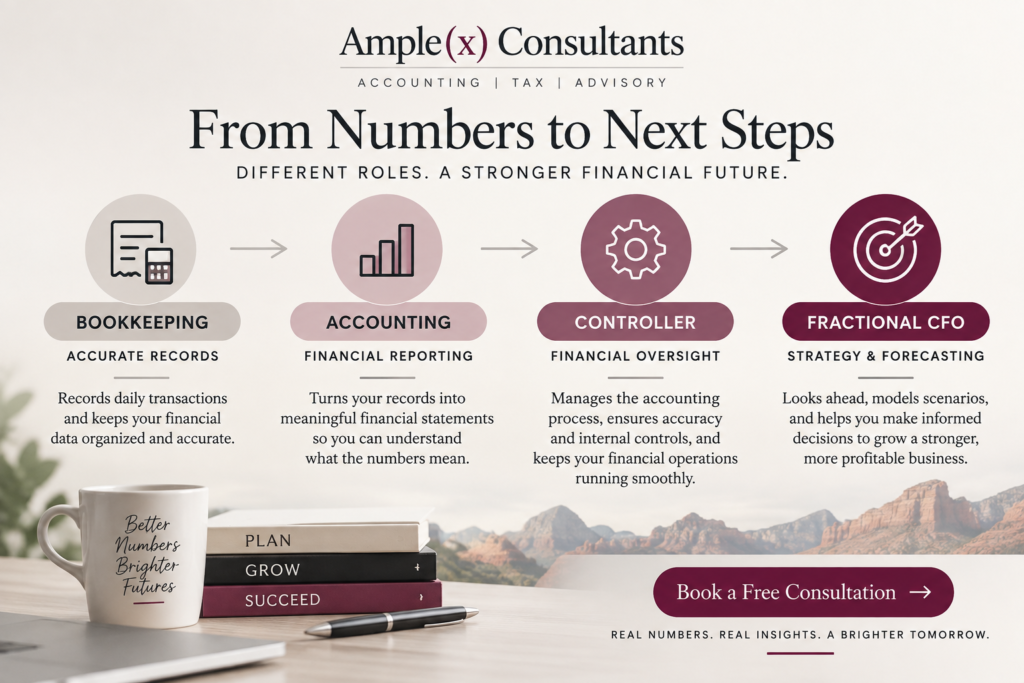
Think of the financial function as a progression:
Bookkeeping → accurate records
Accounting → meaningful financial reports
Controller → reliable financial processes
CFO → financial strategy and forecasting
The mistake is assuming that one person or one service automatically covers all four.
A bookkeeper shouldn’t be expected to provide high-level financial strategy simply because they have access to QuickBooks. Likewise, hiring an expensive CFO doesn’t solve a bookkeeping problem if the underlying financial records aren’t accurate.
The right structure gives each level of financial work the attention it actually requires.
When Should a Growing Business Add More Financial Support?
There’s no single revenue number that determines when you need additional support.
Complexity matters just as much as revenue.
A business with multiple entities, employees, locations, projects, inventory, financing, or complicated payroll may need higher-level accounting support sooner than a simpler business generating the same revenue.
Some warning signs include:
- You’re making decisions based primarily on the bank balance.
- Financial reports arrive late or aren’t reviewed regularly.
- You don’t know which jobs, customers, or services are actually profitable.
- Cash-flow surprises happen frequently.
- The owner is managing too much of the accounting process.
- You’re considering significant hiring or expansion without a forecast.
- You have financial statements but aren’t sure what decisions to make from them.
Those are signs that the business may have outgrown basic bookkeeping alone.
Build the Financial Team Your Business Actually Needs
The goal isn’t to collect financial job titles. It’s to create a financial function that grows with the business.
For some companies, that means reliable bookkeeping and monthly reporting. Others need controller-level oversight, forecasting, and ongoing CFO guidance.
AmpleX Consultants provides bookkeeping, accounting, controller, and fractional CFO services that can be structured around the level of support a growing business actually needs.
You don’t necessarily need four full-time financial employees. You need the right financial expertise at the right time.